- The study read 47,819 European reports that named semaglutide, from 1 January 2018 to 31 December 2025.
- 234 of them involved a potential counterfeit product. That is 0.49 percent.
- 89.3 percent of those 234 were serious. Seven listed death.
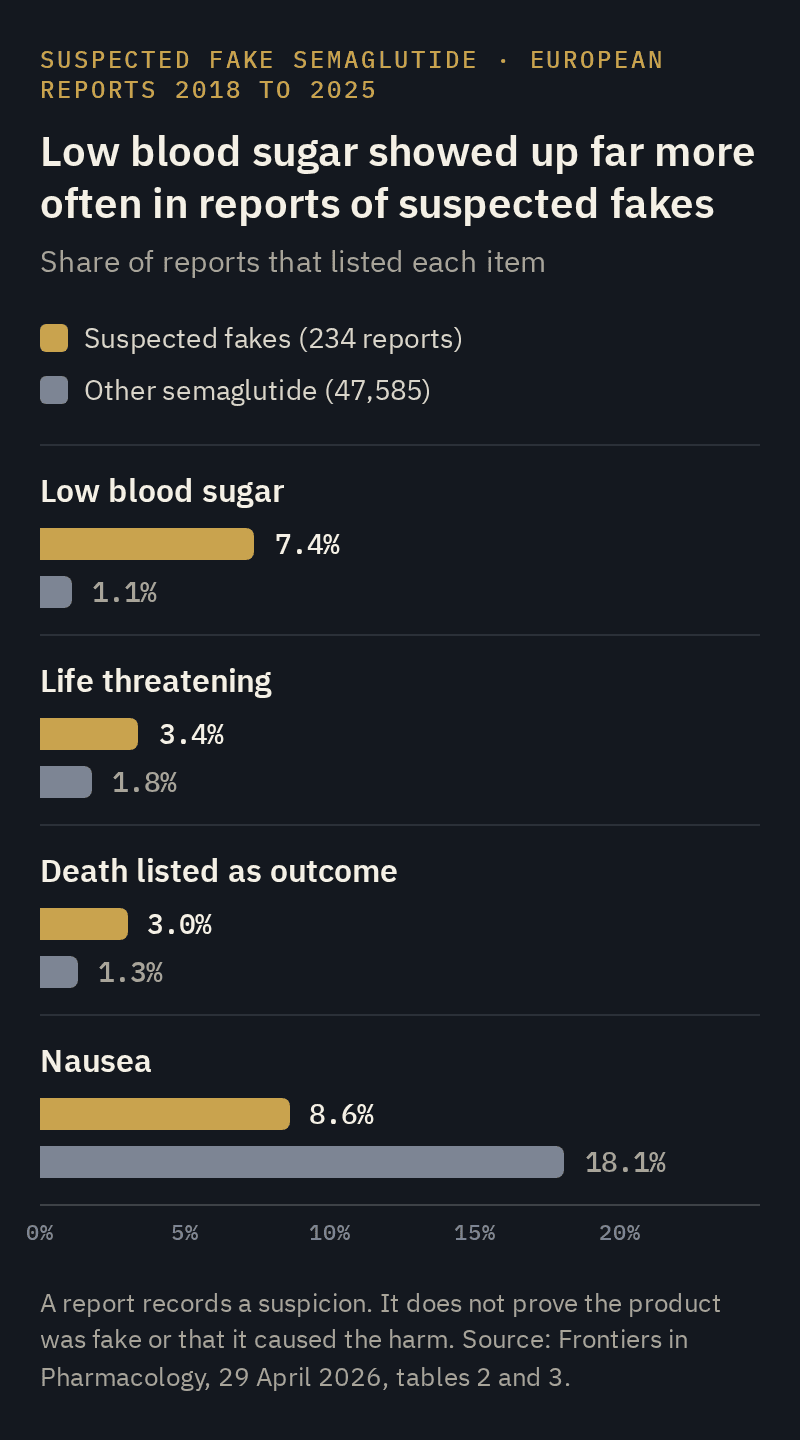
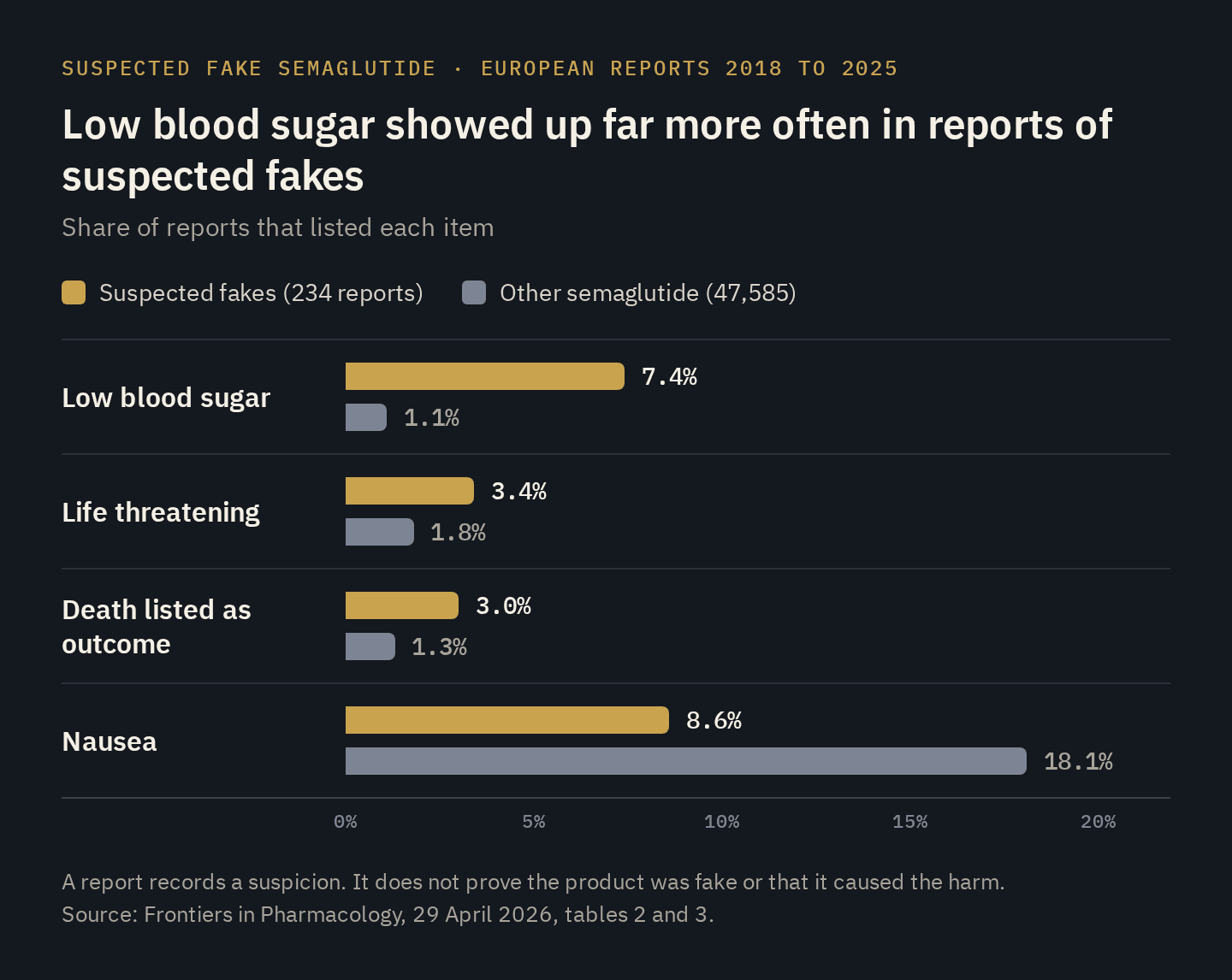
- Low blood sugar was reported in 7.4 percent of the suspected-fake reports, against 1.1 percent of the rest.
- The authors suggest insulin or another toxic substance in the fakes may explain it. Nobody tested the products.
What did the reports on suspected fake semaglutide show?
The reports on suspected fake semaglutide were more often serious than other semaglutide reports. They also listed death and life-threatening events at about twice the rate.1
| What the report said | Suspected fakes (234) | Other semaglutide (47,585) |
|---|---|---|
| Serious | 209 (89.3%) | 31,763 (66.7%) |
| Life threatening | 8 (3.4%) | 875 (1.8%) |
| Results in death | 7 (3.0%) | 626 (1.3%) |
| Caused or prolonged a hospital stay | 43 (18.4%) | 11,348 (23.8%) |
- Suspected fakes (234)
- 209 (89.3%)
- Other semaglutide (47,585)
- 31,763 (66.7%)
- Suspected fakes (234)
- 8 (3.4%)
- Other semaglutide (47,585)
- 875 (1.8%)
- Suspected fakes (234)
- 7 (3.0%)
- Other semaglutide (47,585)
- 626 (1.3%)
- Suspected fakes (234)
- 43 (18.4%)
- Other semaglutide (47,585)
- 11,348 (23.8%)
The suspected-fake reports also listed more side effects each. The middle report named 4, against 2 for the rest.
Semaglutide is the drug in Ozempic and Wegovy. The semaglutide record has its approvals and trials.
Why does fake semaglutide show more low blood sugar?
Fake semaglutide reports listed low blood sugar about seven times as often as other semaglutide reports. The authors suggest the fakes may hold insulin. Nobody in the study tested a product to find out.1
Hypoglycaemia, the medical word for low blood sugar, appeared in 24 of the suspected-fake reports. That is 7.4 percent. Among all other semaglutide reports it was 1.1 percent.
The study's own measure of that gap is a reporting odds ratio of 10.27. That compares how often a side effect is reported, and it says nothing about how often it happens.
The authors write that the gap "may be related to the presence of insulin or other potentially toxic substances in counterfeit semaglutide products". That line rests on regulators' earlier warnings about fakes, which the paper cites.
"May" is the authors' word. It stays here.
Where do the suspected fake semaglutide reports come from?
Most suspected fake semaglutide reports came from outside Europe's own economic area. 197 of the 234 did, or 84.2 percent. Among all other semaglutide reports, that share was 57.5 percent.1
The database is European, but it also takes reports from other countries. The paper does not say where the products were bought.
Who filed the reports matters too. 100 came from health workers. The other 134 came from people who were not health workers.
The paper's introduction describes online shops that "illegally direct users to purchase illicit drug products". It gives no data on where these 234 people got theirs. Our earlier article on semaglutide bought online with no prescription covers what one lab found in those vials.
Does a report prove fake semaglutide caused the harm?
A report does not prove that fake semaglutide caused the harm, and the authors say so. Their words: the results "should be interpreted as reporting associations rather than evidence of causality".1
The cases were picked by the words a reporter used, such as "product counterfeit". No one checked each one by hand. The paper calls them "suspected counterfeit products rather than analytically confirmed falsified medicines".
So some of the 234 may have been the real drug. The paper also warns that "other counterfeit exposures may not have been recognized or reported as such". It has no count of how many people used each kind of product.
The authors spell out what follows: "it is not possible to calculate incidences or other risk measures". Nobody can say from this paper how often a fake product hurts someone.
Are fake semaglutide reports going up?
Fake semaglutide reports went up over the study's years. The first was recorded in 2020, and the count peaked in 2025, the last year counted.1
The study ends on 31 December 2025. Any reports filed since then are not in it.
A rising count can mean more fakes, or more people who know to report one. The paper does not say which.
What nobody has shown
- What was in any of these 234 products. No product was tested.
- How often a fake product causes harm. The study has no count of users.
- Whether the seven deaths were caused by the product. A report lists an outcome, not a cause.
- Where the products were bought.
The other side
234 reports is a small number, out of 47,819. The authors say the small sample may limit "the statistical precision of some analyses".
The serious share needs care too. The authors note a reporting bias, "with serious events more likely to be reported". Media attention and warnings about fakes "may have contributed to stimulated reporting", they add.
Some side effects were reported less often with the suspected fakes. Nausea was 8.6 percent against 18.1 percent for the rest. Hospital stays were also a smaller share, 18.4 percent against 23.8 percent.
The paper's own conclusion is careful. It says suspected fakes "may be associated with distinct reporting patterns", and that the results "should be interpreted with caution".
What would change this
- Lab tests of the products named in these reports.
- A study that follows people who used a fake product, with a count of how many there were.
- Regulators' own case files, matched to what was in each pen or vial.
Three questions to ask next
Last checked: 18 October 2026.
- [1] Unmasking counterfeit semaglutide: analysis of real-world safety data from EudraVigilance (opens in new tab). Zinzi A, Gaio M, Ruggiero R, and others. Frontiers in Pharmacology, 29 April 2026; volume 17Back to text (first mention of source 1)