- In this study, people on GLP-1 drugs had the problem about 11 times more often.
- Most cases came as people were waking up after surgery.
- 2 people had stomach contents go into their lungs.
- About 4 in 10 GLP-1 users got the drug outside their family doctor or a specialist.
- The study shows a link. It does not prove the drugs caused it. See our semaglutide record.
What happened to people on GLP-1 drugs during surgery?
People on GLP-1 drugs were far more likely to have stomach contents come back up during surgery. That was the main finding of a study at 119 sites across the UK.1
Here are the numbers in plain terms.
| Patients | How many | Stomach contents came up | That is about |
|---|---|---|---|
| Not on a GLP-1 drug | 45,691 | 57 | 1 in 802 |
| On a GLP-1 drug | 1,348 | 19 | 1 in 71 |
- How many
- 45,691
- Stomach contents came up
- 57
- That is about
- 1 in 802
- How many
- 1,348
- Stomach contents came up
- 19
- That is about
- 1 in 71
Picture a waiting room with 71 people on a GLP-1 drug. In this study, about 1 of them had this happen. Now picture a hall with 802 people who are not. Again, about 1.1
The release says people on the drugs were "11 times more likely" to have it happen.2 About 1 in every 36 patients in the study was on one.1
Why can a GLP-1 drug leave food in the stomach?
A GLP-1 drug can leave food in the stomach because it slows how fast the stomach empties. The study opens on that fact.1
The release puts it in plain words. These drugs slow "the rate at which food and fluid leave the stomach."2
That is the problem with fasting. Normal fasting before an operation "may not result in an empty stomach," the release says.2
Under anaesthesia, stomach contents can come back up into the mouth. From there they can go into the lungs. Doctors call that aspiration.12
Mounjaro's own label says it too: "MOUNJARO delays gastric emptying." It also carries a warning called "Pulmonary Aspiration."3 Our Mounjaro article shows what that slowing does to the pill.
When is the danger highest on a GLP-1 drug?
The danger on a GLP-1 drug was highest at the end, as people woke up. About half of the cases happened then.2
The release gives the split. 53 percent came while waking up. 13 percent came at the start. 13 percent came during surgery.2
Of the 19 people, 17 had stomach contents come up. 2 had them go into their lungs.2
Doctors used a range of methods to protect the airway. "Despite this," the problem still came at 1 in 71.1
Can doctors miss that a patient is on a GLP-1 drug?
Doctors can miss that a patient is on a GLP-1 drug, the release suggests. More than 40 percent of the GLP-1 users got their medicine outside their family doctor or a specialist.2
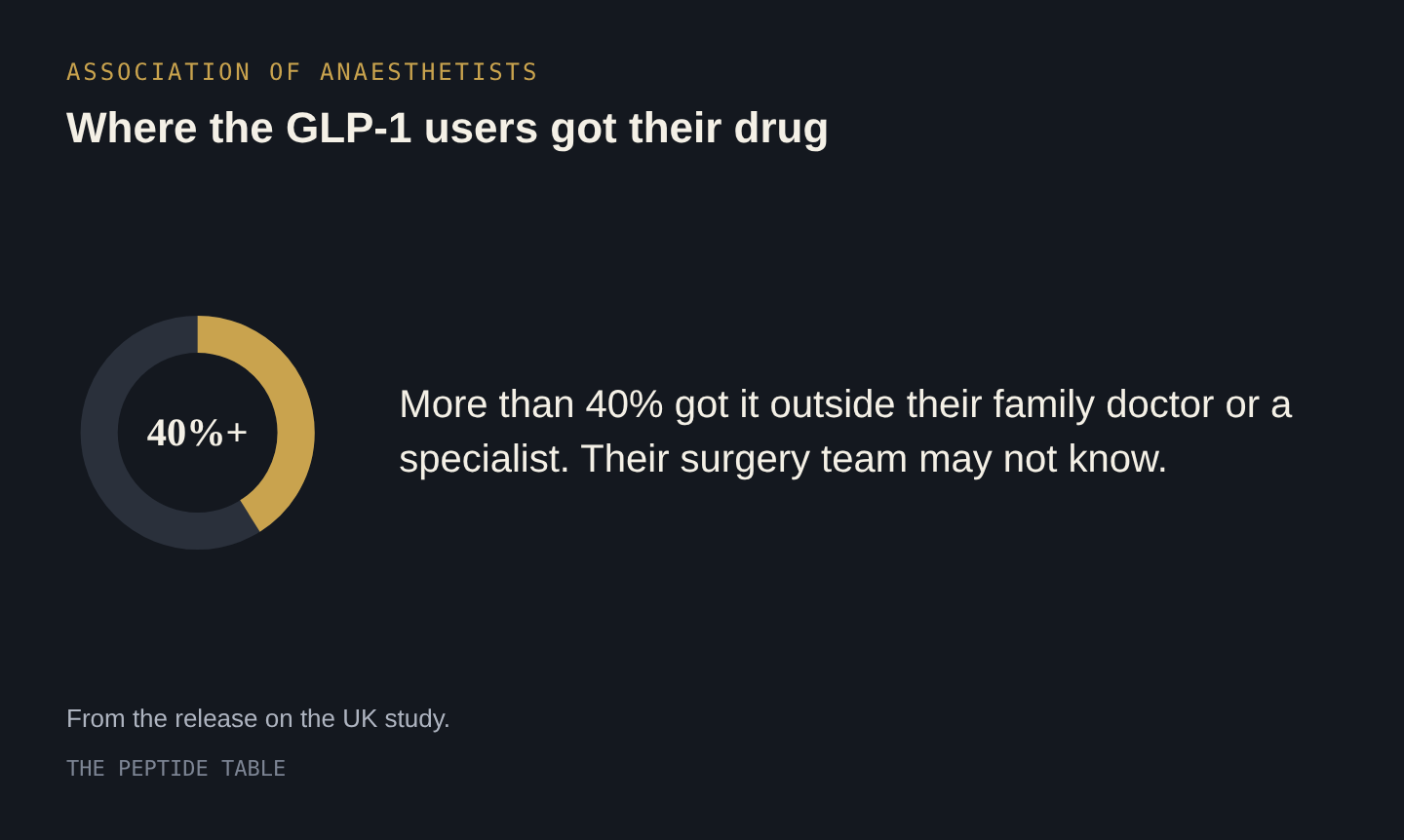
Some patients may not have said they were on the drugs at all. Some staff who screened patients were not part of the study.2
So the real number of GLP-1 users going under "could be underestimated," the release says.2 It puts the share at around 3 percent of UK surgery patients.2
Doctors may also have been "reluctant to report" every case, the release adds.2
Advice on pausing the drugs was all over the place. Nearly 1 in 3 patients had been told to hold their GLP-1 drug before surgery.2 Our article on buying semaglutide online shows where some of these drugs come from.
Do GLP-1 drugs cause this, or is it something else?
Nobody has shown that GLP-1 drugs cause this. The authors say the link "may be due to unmeasured confounding." That means something else could explain part of it.2
They name two things. "Obesity and diabetes are known risk factors for pulmonary aspiration," they write. Both were common in the GLP-1 group.2
They also say their data "may underestimate" cases in people not on the drugs.2 That would make the gap smaller.
The release calls the risk "very small" for any one person. It also calls the gap between the groups "of clinical concern."2
What nobody has shown
- That GLP-1 drugs cause the problem. The study found a link.
- How long the drugs need to be held for the stomach to empty. The release calls this "unclear."2
- Whether anyone was harmed for good. The summary does not report a death or lasting harm from these cases.
- Whether drugs bought outside the usual routes change the picture. The study did not split them out.
The other side
The risk for any one person is small. In this study, 1,329 of the 1,348 GLP-1 users had no problem recorded, by our count.1
People in the GLP-1 group more often had obesity and diabetes. Those raise the risk on their own, the authors say.2
For people not on the drugs, the rate was 1 in 802. That fits an earlier national check, at about 1 in 660.2 The authors also call their data "not generalisable."2
What would change this
- A study that compares GLP-1 users with people of the same weight and health.
- Research on how long the drugs should be paused, if at all.
- Results from other countries.
Three questions to ask next
Last checked: 1 November 2026.
- [1] Peri-operative glucagon-like peptide-1 receptor agonist use and outcomes: a national prospective multicentre cohort study (opens in new tab). Potter TE, Cronin JN, Kua J, and others, for the GLIMPSE Resident Research Networks and Collaborators, Anaesthesia, published online 16 September 2026, doi 10.1111/anae.70380, PMID 42748560 (abstract and plain language summary)Back to text (first mention of source 1)
- [2] Association of Anaesthetists (opens in new tab). News release on the study, released 18 September 2026, as posted by ScimexBack to text (first mention of source 2)
- [3] Eli Lilly and Company (opens in new tab). Mounjaro (tirzepatide) prescribing information, revised August 2026, on DailyMed, warning 5.9Back to text (first mention of source 3)