- Victoria counted six cases of acute liver injury since January 2026 in people who used products labelled retatrutide.
- Its health department says the harm is "possibly associated with a contaminant", and that "all such products are at risk".
- The TGA tested one vial sold as retatrutide. It found semaglutide, about 8 times the level in approved products, and no retatrutide.
- Retatrutide is still in human trials. The TGA says any retatrutide outside a trial "could be a counterfeit product".
What did Australia's lab find in a vial sold as retatrutide?
Australia's Therapeutic Goods Administration found no retatrutide in a vial sold as retatrutide. Its lab found "undeclared semaglutide" instead, at about 8 times the level in approved semaglutide products.2
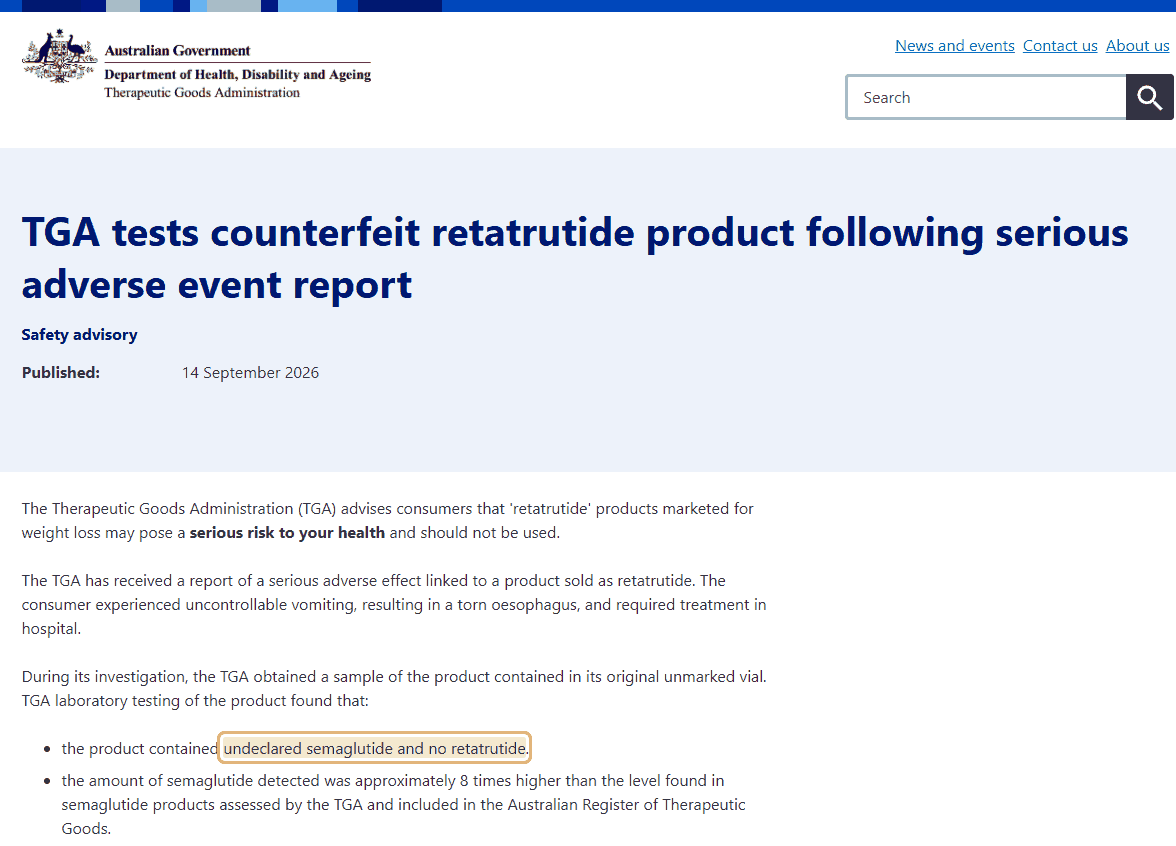
The test followed a report of serious harm. In the TGA's words, "The consumer experienced uncontrollable vomiting, resulting in a torn oesophagus, and required treatment in hospital."
The TGA got a sample "contained in its original unmarked vial". So the vial bore no markings.
The full finding on strength reads: "approximately 8 times higher than the level found in semaglutide products assessed by the TGA". Semaglutide is the drug in Ozempic and Wegovy.
This is one vial. The TGA does not say how many others it tested.
What liver injuries are linked to products labelled retatrutide?
Victoria's health department counted six cases of acute liver injury in people who used products labelled retatrutide. The cases run from January 2026. Its alert was issued on 19 June 2026 and was marked "Active" when we read it.1
The alert names the labels: Retatrutide, Reta, R-10 and R-20. It says "it is believed similar cases may have been reported in some other Australian jurisdictions."
The patients had tiredness or malaise, jaundice, abdominal pain, dark urine and abnormal bruising. Their tests showed "transaminitis with possible raised bilirubin and coagulopathy". In plain words: raised liver enzymes, and blood that may not clot as it should.
The department points to a possible contaminant. It writes that the toxic effects are "possibly associated with a contaminant in the products labelled as 'Retatrutide' and all such products are at risk."
It adds that "additional contaminants may be contributing to the observed liver toxicity". In June it said "Further investigation of the contents of these products is underway."
Is retatrutide approved anywhere?
Retatrutide is not approved anywhere, according to Australia's regulator. The TGA says it "has not been approved by the TGA or any comparable international regulator".2
The TGA describes it as "currently undergoing clinical trials in humans". Victoria calls it "an experimental drug not approved for sale as a safe medical product in Australia".12
That leads to the TGA's hardest line: "Any retatrutide product accessed outside of clinical trials could be a counterfeit product."
The retatrutide record lists the trials that exist.
What is in a vial labelled retatrutide?
Nobody can know what is in a vial labelled retatrutide without testing it, by the TGA's account. Its Chief Medical Adviser named that as the main danger.2
Professor Robyn Langham said: "The biggest risks with unapproved peptide products are not knowing what is in the vial, how much of or even what substance it contains, whether it is sterile, or whether it contains other contaminants or toxins."
She added that the risks are "particularly concerning for injectable products". Dirty or non-sterile production, she said, "can increase the risk of infection and harmful immune responses including anaphylaxis".
Victoria's alert lists "potentially life-threatening reactions" among the risks of unapproved peptides.1
A label on a vial is a claim, and so is the paper that comes with it. Our article on forged lab certificates shows how far that paper can go.
Where did people get the retatrutide products?
The retatrutide products in Victoria's cases were bought online, through friends and through social media accounts. That is how the health department describes it.1
It says retatrutide "is marketed widely online for muscle growth, fat loss, recovery and anti-ageing."
The TGA warns that products sold online "may be fake or counterfeit and could contain undisclosed or incorrectly dosed ingredients". It names unmarked vials and goods from overseas as a particular worry.2
Selling unapproved medicines in Australia carries penalties. The TGA lists criminal penalties of up to 7 years in prison.
What nobody has shown
- What caused the six liver injuries. The department said the contents were still being tested.
- What the contaminant is, if there is one.
- How many vials sold as retatrutide hold no retatrutide. The TGA reported one test.
- Whether the cases in other Australian jurisdictions were confirmed. The alert says "it is believed".
The other side
Victoria's alert links the liver injuries to a possible contaminant, not to retatrutide. Real retatrutide is in human trials, and nothing here is a finding about the drug itself.
Six cases is a small count. The alert gives no number of people who used these products without harm.
The torn oesophagus came from one product with no retatrutide in it. That vial is evidence about fakes, and says nothing about the trial drug.
What would change this
- Victoria's results from testing the products tied to the liver cases.
- More TGA tests of vials sold as retatrutide.
- Published results from the trials of retatrutide, read by a regulator.
Three questions to ask next
Last checked: 18 October 2026.
- [1] Toxicity linked to unapproved peptide product labelled Retatrutide (opens in new tab). Department of Health, Victoria. Health alert issued by Dr Caroline McElnay, Chief Health Officer, 19 June 2026Back to text (first mention of source 1)
- [2] TGA tests counterfeit retatrutide product following serious adverse event report (opens in new tab). Therapeutic Goods Administration. Safety advisory, 14 September 2026Back to text (first mention of source 2)