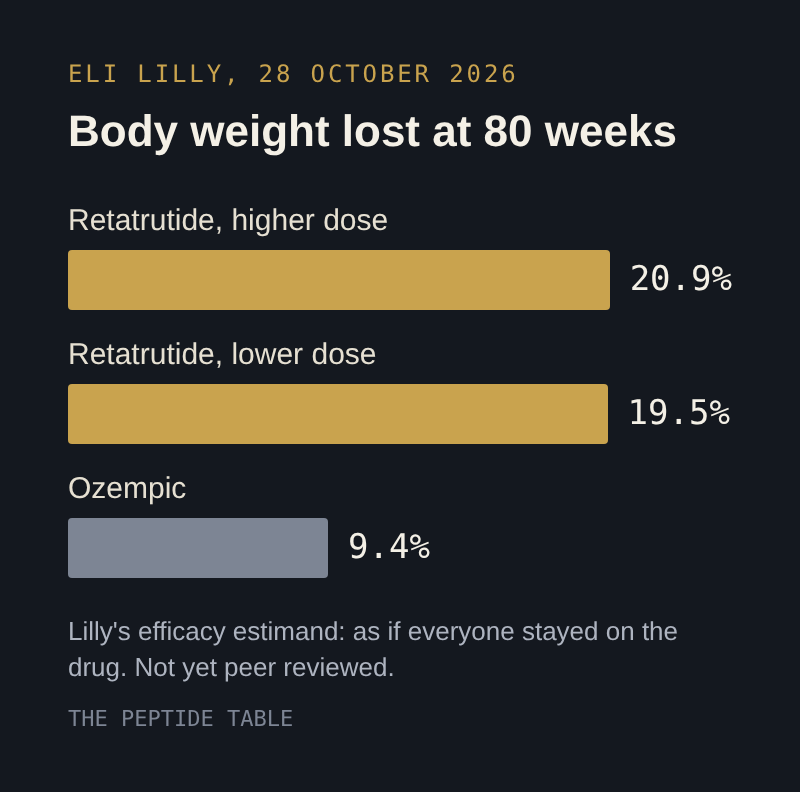
- The trial put 1,298 adults with type 2 diabetes on retatrutide or Ozempic for 80 weeks.
- Weight fell 19.5 and 20.9 percent in the two retatrutide groups, against 9.4 percent on Ozempic.
- 7.9 percent of the higher-dose retatrutide group stopped because of side effects. On Ozempic, 2.7 percent did.
- Dysesthesia, an odd or painful feeling in the skin, showed up in up to 6.5 percent on retatrutide.
- Retatrutide is not approved anywhere. Lilly says anyone selling it to consumers "is breaking the law." See our retatrutide record.
What did the retatrutide vs Ozempic trial find?
The retatrutide vs Ozempic trial found bigger drops in blood sugar and weight with retatrutide, according to Lilly. The trial is called TRANSCEND-T2D-2. It ran 80 weeks in adults whose diabetes was not controlled on metformin.1
| At 80 weeks | Retatrutide, lower dose | Retatrutide, higher dose | Ozempic |
|---|---|---|---|
| Change in A1C (a blood sugar measure) | -2.2% | -2.2% | -1.8% |
| Change in body weight | -19.5% | -20.9% | -9.4% |
- Retatrutide, lower dose
- -2.2%
- Retatrutide, higher dose
- -2.2%
- Ozempic
- -1.8%
- Retatrutide, lower dose
- -19.5%
- Retatrutide, higher dose
- -20.9%
- Ozempic
- -9.4%
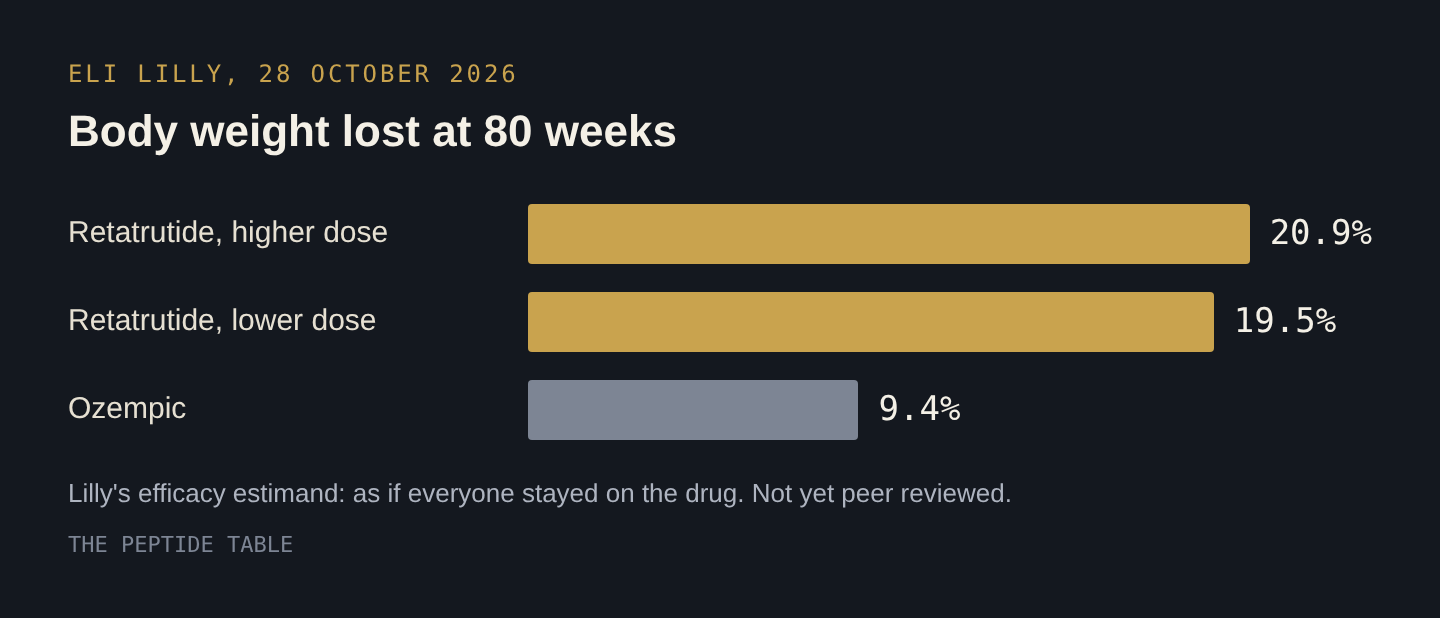
Lilly's headline says retatrutide gave "more than double the weight loss of Ozempic's highest approved dose."1
The company also says retatrutide did better on some heart risk markers. It names cholesterol, triglycerides and blood pressure.1 Our semaglutide record covers Ozempic's own trials.
Did more people quit retatrutide over side effects?
More people quit retatrutide over side effects than quit Ozempic, by Lilly's own count. In the higher-dose group, 7.9 percent stopped treatment because of adverse events. In the lower-dose group, 4.8 percent did. On Ozempic, 2.7 percent did.1
Put simply, that is about 8 in 100 people on the higher dose, against about 3 in 100 on Ozempic. By our arithmetic, the higher-dose quit rate is nearly three times Ozempic's. Lilly does not put it that way.
Stomach problems led the list. Diarrhea hit 32.7 percent of the higher-dose group, against 26.4 percent on Ozempic. Vomiting hit 15.0 percent, against 13.2 percent.1
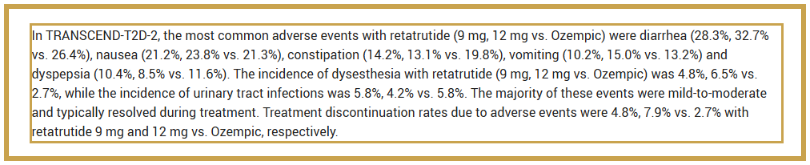
Lilly writes that most of these events were "mild-to-moderate and typically resolved during treatment."1 It does not say which side effects made people stop.
What is dysesthesia, and how often did it show up with retatrutide?
Dysesthesia showed up more often with retatrutide than with Ozempic in this trial. The word means an odd or painful feeling in the skin. Lilly's release gives the number without defining it.1
| Dysesthesia, at 80 weeks | Share |
|---|---|
| Retatrutide, higher dose | 6.5% |
| Retatrutide, lower dose | 4.8% |
| Ozempic | 2.7% |
- Retatrutide, higher dose
- 6.5%
- Retatrutide, lower dose
- 4.8%
- Ozempic
- 2.7%
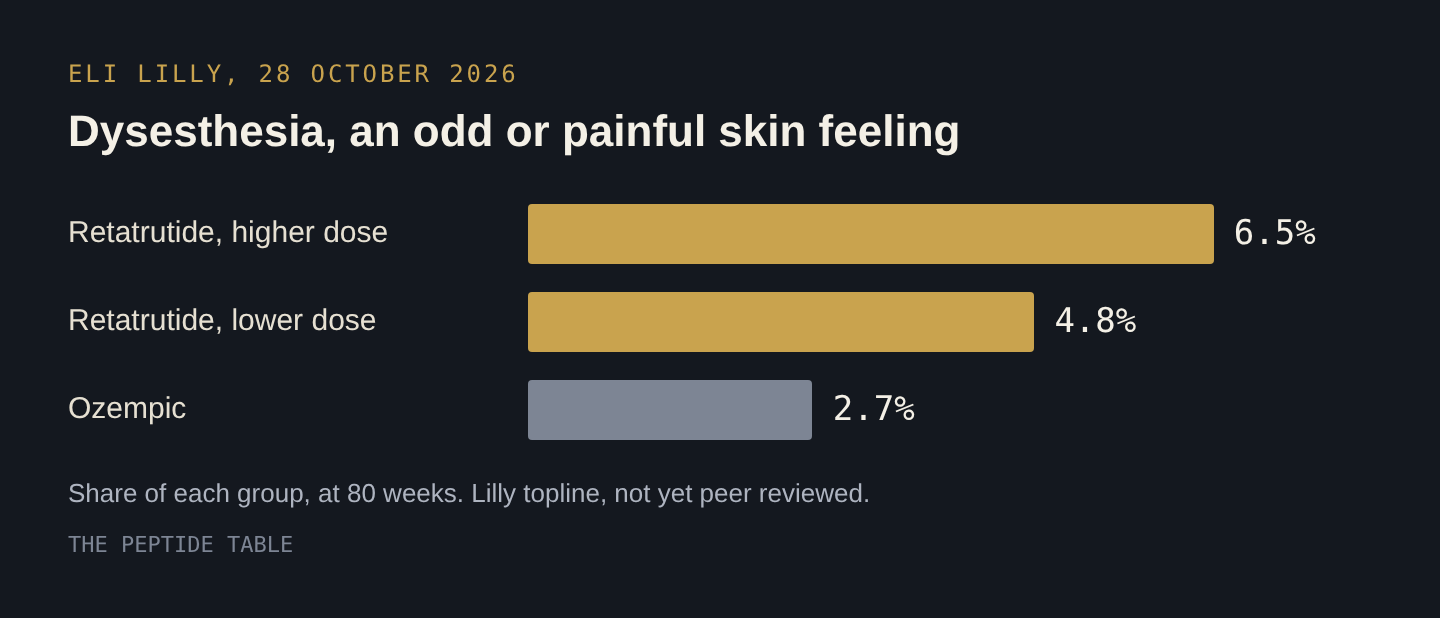
That is more than twice the Ozempic rate in the higher-dose group, by our arithmetic. Lilly's release does not say how long it lasted, or whether anyone quit because of it.1
Our article on a fake retatrutide vial shows what happens outside a trial.
What does "efficacy estimand" mean in the retatrutide results?
The "efficacy estimand" means the retatrutide results assume everyone stayed on their drug. Lilly says every number in the release uses it.1
Lilly's own definition: it "represents efficacy had all randomized participants remained on study intervention (with possible dose interruptions and modifications) for 80 weeks".1
So the weight loss figures describe people as if nobody stopped. Yet the release itself says some did, and more of them on retatrutide.1

The trial was also "open-label," Lilly says.1 The trial's own registry entry says the same: "None (Open Label)."2 That means the people in it, and their doctors, knew which drug they got. That can sway how side effects get reported.

Is retatrutide approved for anyone yet?
Retatrutide is not approved for anyone, anywhere. Lilly calls it "an investigational molecule that has not been approved by FDA or any regulatory organization anywhere in the world."1

The same release adds: "Anyone purporting to sell retatrutide to consumers is breaking the law."1
Lilly says TRANSCEND-T2D-2 is the sixth Phase 3 trial where retatrutide "delivered powerful efficacy."1 A head-to-head trial against tirzepatide, called TRIUMPH-5, is still running. See our tirzepatide record.
Lilly says the detailed results "will be presented at a future medical meeting and published in a peer-reviewed journal."1 No date is given.
What nobody has shown
- The full trial results. Only a press release exists.
- Which side effects made people quit retatrutide.
- How long the dysesthesia lasted, or how bad it got.
- How the results look counting the people who stopped. The release reports only the "efficacy estimand".
- What is inside any vial sold online as retatrutide. These numbers are about Lilly's drug in a trial.
The other side
The trial was large and randomized, with 1,298 adults across three groups.1
Lilly says retatrutide met the trial's main goal on blood sugar and all its key secondary goals. It reports the weight results as statistically significant.1
Most side effects were stomach problems, the same kind Ozempic causes. Constipation was more common on Ozempic, at 19.8 percent, than on either retatrutide dose.1
By our arithmetic, more than 92 in 100 people in that group did not quit over side effects. Peer review may confirm these numbers or change how they read.
What would change this
- The peer-reviewed paper, with the full side effect tables and quit reasons.
- Results that count everyone, including those who stopped.
- The TRIUMPH-5 results against tirzepatide.
- A regulator's review of the full data.
Three questions to ask next
Last checked: 2 November 2026.
- [1] Lilly's retatrutide delivered greater A1C reduction and more than double the weight loss of Ozempic's highest approved dose in head-to-head trial (opens in new tab). Eli Lilly and Company, press release, 28 October 2026Back to text (first mention of source 1)
- [2] ClinicalTrials.gov (opens in new tab). Record NCT06260722, "Effect of Retatrutide Compared With Semaglutide in Adult Participants With Type 2 Diabetes and Inadequate Glycemic Control With Metformin With or Without SGLT2 Inhibitor (TRANSCEND-T2D-2)", last update posted 28 September 2026, read 2 November 2026Back to text (first mention of source 2)